2009-11-14
Getting Ready For Atlantis
Mission managers at NASA have cleared Atlantis to launch the STS-129 mission on Monday at 2:28pm EST (19:28 GMT), after an unmanned Atlas launch scheduled for today was scrubbed due to a power glitch. The six astronauts arrived at the cape on Friday to prepare for the launch and to begin the countdown. The countdown team is not currently working any technical issues, and the weather looks promising with over 90% chance of favorable conditions.
The STS-129 crew arrives at Kennedy
The crew are, Leland Melvin, Barry E. Wilmore, Charlie Hobaugh, Randy Bresnik, Mike Foreman, and Robert Satcher. They will be joined on the return to Earth by Nicole Stott, a crewmember currently on the ISS. Preparations to ready Atlantis for launch ended Friday morning with the closing of the payload bay doors, sealing in the two ExPRESS Logistics Carrier (ELC) units which will be installed on the ISS during the mission. Also making the trip is a device known as the Commercial Orbital Transportation Services Ultra High Frequency Communication Unit, which will facilitate communications with the future SpaceX Dragon spacecraft - the first commercial spacecraft capable of delivering cargo and crew to the ISS, due to begin operations in 2010.
The Rotating Service Structure - the logistical frame surrounding the Shuttle and payload bay at the launch pad - will be rolled away to reveal Atlantis in ready to launch profile. Commander Charlie Hobaugh and pilot Barry Wilmore have begun practice landings in the Shuttle training aircraft - a modified Gulfstream II jet that accurately simulates the performance of the Shuttle.

The Gulfstream II Shuttle training aircraft in action
This will be Atlanis' penultimate flight, and with only six STS missions remaining on the launch manifest we are now entering the final stages of the historic Shuttle programme. Enjoy these launches while you can, there will be one long gap before NASA puts people into space again.
Happy Launching Spacers!
SpaceHead
Images credit: NASA TV and NASA/Kim Shiflett


2009-11-13
Water Found On The Moon!
All of the data gathered from the October 9th impact of the LCROSS (Lunar CRater Observation and Sensing Satellite) probe has now been analyzed, and NASA has found HUGE amounts of water on the Moon!The site of the impact was carefully chosen and has been shaded from direct sunlight for billions of years. The team at NASA concentrated their analysis of spectrometer data from the satellite, which provided the most definitive information about the presence of water. They were surprised by the abundance of water that they found, and now believe that it could be a lot more widespread than they had initially predicted. There are many craters at the polar extremes of the Moon that have areas unexposed to sunlight, and given that the impact history of the Moon includes countless comets that are composed entirely of water ice, it has now been shown that these sunless areas can hold on to that water for a very long time.

Enhanced view of the LCROSS impact plume
So, is this really that big a deal then?
Well, yes it is is a very big deal. The presence of water on the Moon means that it is less of a logistical headache for us to go there, and stay longer than to just plant flags and leave footprints. We can extract the water there and use it for human consumption and fuel. Without it we would have to haul all the water and fuel that we need up with us, and that's not a cheap or easy thing to do. Launch cost per pound is still around the $100,000 mark, which believe it or not makes a bottle of water on the Moon more expensive than some of those high-end waters - or scams, as I like to call them - here on Earth.

The LCROSS impact data
It is now possible to think realistically about a permanent base on the Moon, and a resource of water means that base can be self-sustaining. Not only can fuel and drinking water be produced, but hydroponics becomes a viable way to produce raw materials and foods. Launching from the Moon with its one sixth gravity of Earth is a lot less expensive and requires significantly less fuel - most of the fuel in a launch from Earth is used to launch the extra fuel required to get away from the gravitational influence of Earth.
With this announcement alone, expect very ambitious plans to be drawn up now that not only include a permanently manned moonbase, but also a spaceport that will be a jumping off point to Mars and beyond. The news is THAT big!
Happy Mooning Spacers!
SpaceHead
Images credit: NASA
2009-11-12
Rosetta Snaps Crescent Earth
As it hurtles toward its Friday close pass of Earth, the European Rosetta spacecraft took this remarkable snap of our home planet, looking like a blue crescent moon hanging in space. Go ahead and click it to en-massive-ify.
Home
According to the ESA team: The illuminated crescent is centered roughly around the South Pole (South at the bottom of the image). The outline of Antarctica is visible under the clouds that form the striking south-polar vortex. Pack ice in front of the coastline with its strong spectacular reflection is the cause for the very bright spots on the image.
[update]Rosetta has been taking regular pictures during the course of its Earth pass, and ESA will be releasing them as a video shortly. Too cool!
Rosetta will make its closest approach on Friday at 08:45 CET.
Everybody wave!
SpaceHead
Image credit: ESA © 2009 MPS for OSIRIS Team MPS/UPD/LAM/IAA/RSSD/INTA/UPM/DASP/IDA
2009-11-11
Rosetta To Buzz Home
The ESA probe Rosetta is in the midst of several gravity assist moves as it fine-tunes its orbit to eventually land on comet 67/P Churyumov-Gerasimenko in 2014. This Friday, November 13th it makes a close approach to Earth at 08:45 CET, buzzing past its home planet to pick up speed at a whopping 29,000mph.
Artist view of Rosetta
Rosetta is an ambitious spacecraft that has been designed to operate both close in to the Sun and farther out past Mars, where it will use layers of insulation to keep itself warm. As it passes Earth and the Moon this time it will add its sensor data to the search for water on the Moon, calibrating its science instruments as it goes. Then it's off into the loneliness of interplanetary space until it gets to Mars, where it will make one final gravity assist move to eventually match the speed of the comet. En route to the comet, the probe will flyby the asteroids 2867 Steins (September 2008) and 21 Lutetia (July 2010).
Equipped with a lander probe, Rosetta will be the first spacecraft ever to attempt landing on a comet, and will provide clues to the physical and chemical processes at work during the formation of planets, beginning 4.6 billion years ago.
Rosetta took this eerie picture of the Moon on November 8th as it approached.

The Moon from Rosetta
Wish her luck, Spacers!
SpaceHead
Images courtesy of ESA
2009-11-10
New Docking Port Heads To ISS
A new Russian docking port is on its way to the International Space Station (ISS) today, launched from the Baikonur Cosmodrome atop a Soyuz rocket. The Mini-Research Module 2, or MRM-2, is better known as 'Poisk', Russian for 'Explore', and will provide additional storage, an airlock, and a docking port for Progress and Soyuz craft.
Poisk is prepared for launch
Due to dock at the space station Thursday at about 10:43am EST, Poisk is the first new Russian addition to the station since the Pirs docking compartment in 2001. The module's 380 cubic feet of living space was loaded up before launch with Russian Orlan spacesuits and life support equipment, so it will be a mini-delivery for the station too.
The addition of a fourth docking port is essential for the continued presence of a six-person crew at the station, as the current three ports are occupied with two Soyuz crew spacecraft and a Progress craft which will be loaded with trash and released to burn up in reentry. Traffic control will be made a lot easier with the additional port.
Keep an eye on NASA TV on Thursday for live coverage of the docking.
Happy Spacing Spacers!
SpaceHead
Image courtesy of RSC Energia
2009-11-09
Space Elevator Contest Partially Won
The Space Elevator Games is a very interesting contest, essentially proving concepts that may one day lead to a fully operational space elevator. A Seattle company, LaserMotive, snagged $900,000 of the $2 million prize money available by climbing a 3,000 foot cable suspended from a helicopter. They completed the task 4 times with a best time of 3:48. The goal of the prize was to achieve a best time under 3 minutes, so the remaining $1.1 million is still up for grabs.
LaserMotive's climber in action
The concept of a space elevator has been around since Arthur C Clarke first postulated the idea in his 1970's novels. A cable is tethered between the ground and a satellite in geostationary orbit, which is then traversed by a climber that can deliver and return payloads over the 22,000 mile distance. No small task, especially given the problem of getting power to the climber. The emerging technology of power beaming is used in the competition, where a laser is aimed at the climber to supply it with power.
So, isn't this a bit of a far out concept then?
Well, it is certainly ambitious! A space elevator is actually a very viable concept that would open up an entirely new method of access to space. It isn't without its problems though. One major hurdle is that a permanent cable stretching from the equator out to a geostationary satellite is a serious collision hazard, both for aircraft and for existing orbiting infrastructure. The ISS is in Low Earth Orbit and passes over the equator twice every 90 minutes. At some point it will inevitably cross the equator at the location of the elevator cable. An adjustment will have to be made to the ISS orbit to avoid a 17,500mph collision that will destroy both the ISS and the cable. This is of course possible with satellites that are able to adjust their orbits, but with those that cannot, the Hubble Space Telescope for example, it will be only a matter of time before a collision occurs. The problem of space junk becomes more pertinent too, as any one of the thousands of junk objects poses a threat to the cable.
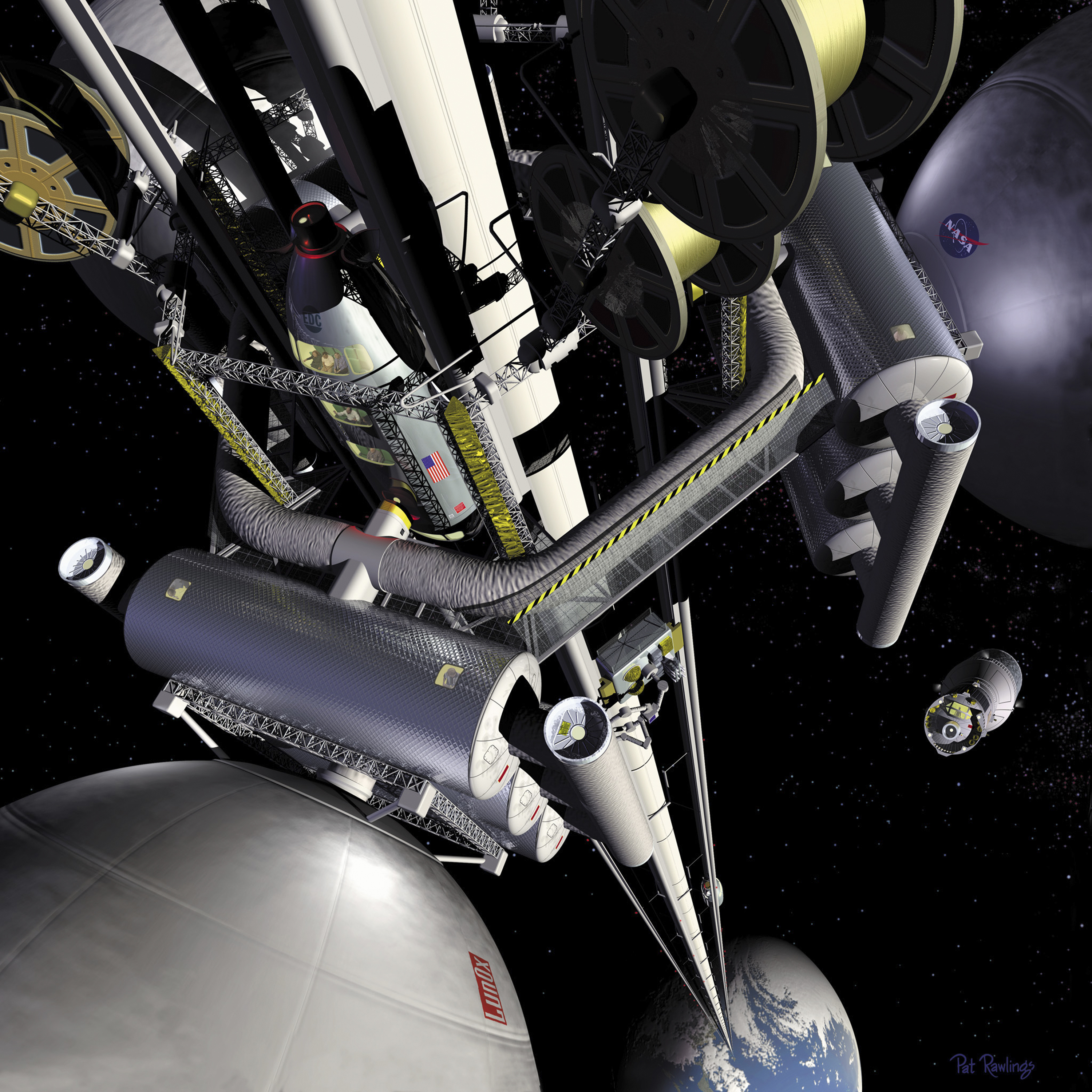
NASA space elevator artists concept
Looking on the bright side however, if the concept were to become viable it would enable the construction of major orbital components at a fraction of the cost, removing entirely the need for expensive and hazardous rocket launches. Attach a small asteroid to the top of the cable as an anchor, and you have a solid location to build an off-world factory. Satellites could be constructed and then released, and a small tug-boat satellite could escort it to its desired orbit.
The technology is of course still not even in its infancy, with the Space Elevator Games producing concepts more than actual working technology, but it is certainly worthy of our attention. It may be a few centuries before we see a cable to the sky in action, so don't hold your breath just yet.
Happy Climbing Spacers!
SpaceHead
Images courtesy of NASA/Tom Tschida and NASA
Space Junk Buzzes ISS
Spacers QuickieA small 2cm piece of space junk passed uncomfortably close to the International Space Station (ISS) late Friday night, whizzing by within 1,600 feet of the orbiting outpost. As a precaution the crew of six were awakened, but as monitoring continued it was clear the object would miss the station and the crew returned to their nights sleep.
Panic over, but they really need to start doing something about the amount of junk in orbit. It's so littered up there that it makes photos of my bedroom as a teenager look tidy!
Happy Trash Duty Spacers!
SpaceHead
Subscribe to:
Posts (Atom)

 Posts
Posts

