2008-06-02
Discovery Damages Pad!
Okay, so I've been away from the keyboard for a while... but space boldly goes on regardless!Last Saturday (May 31st) Space Shuttle Discovery launched on the second of three missions to add the Japanese Kibo laboratory to the International Space Station, and in the process managed to actually damage the launch pad! Launches are known to be extremely violent events, so much so that absolutely NO personnel are permitted within a few miles of the pad. Space Shuttles are heavy beasties on their own, but for this mission, Discovery carried in her belly the largest piece of hardware ever to be launched using the reusable vehicle - the main Kibo laboratory. Every pound of weight on the launch pad required roughly ten pounds of extra fuel to launch, which isn't too difficult to imagine since fuel itself has weight. This particular launch unleashed the biggest surge of energy since the Apollo program, and parts the ageing pad crumbled under the strain.
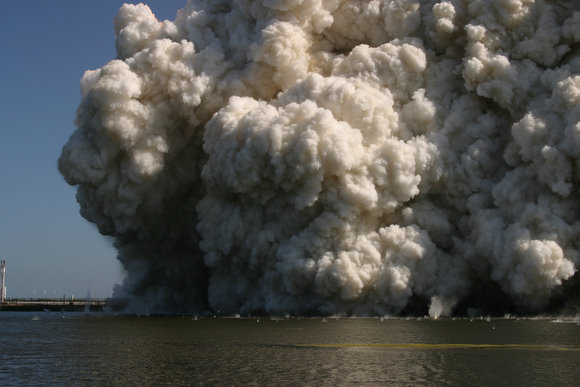
In the image above, large chunks of concrete can be seen splashing into the water after being hurled into the air by the force of the launch.
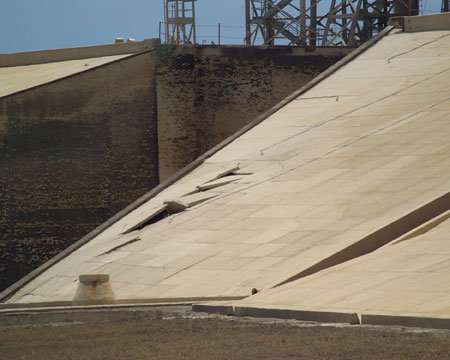
And the damage can clearly be seen after the smoke and dust clears. The so called "flame trench" has to withstand not only incredible heat, but also tremendous pressure from the solid rocket boosters and Space Shuttle main engines.
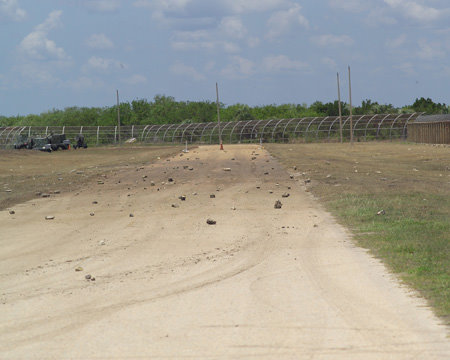
Debris litters the roads surrounding the pad after the launch.
Watch this space for details of the mission.
Happy Spacing Spacers!
SpaceHead


2008-04-22
At Whitson's End
Peggy Whitson, commander of Expedition 16 on the International Space Station, and holder of the record for longest cumulative time in space for an American, ended her tenure with a landing in Kazakhstan with her crewmate Russian Cosmonaut Yuri Malenchenko, and South Korea's first astronaut, 29-year-old bioengineer Yi So-yeon.
Yi described their descent through reentry as "Really scary" as a glitch in the descent profile caused their Soyuz capsule to go through a "ballistic reentry", whereby a much steeper drop through the atmosphere inflicts much higher G loads on the occupants.

Expedition 17 is settling in to their new home and is awaiting the arrival of the STS-124 Space Shuttle mission due to launch on May 31st. Keep an eye on Spacers for coverage of the mission!
Happy Spacing, Spacers!
SpaceHead
2008-04-01
Jules Verne practices approaching
The European Jules Verne spacecraft practiced approaching the ISS on Monday, coming within 36 feet of the orbiting complex. In a series of maneuvres on "Demo Day 2", European ground controllers coordinated with NASA controllers and the crew aboard ISS which proved the automated capability of the craft.
So, what's so special about all this then?
Well, we've all seen the science fiction stuff where automatic spacecraft do crazy stuff without even a hint of people intervention. But, when it comes down to it we here in the real world have very little practical and technical experience of such automation. This is why the space community is very excited about the weeks of tests that Jules Verne is going through, basically it is putting into practice what we have been capable of in theory for years.
So, why don't the just dock the darned thing then?
It's true that one of the purposes of JV is to resupply the ISS, and it certainly contains a bagful of goodies for the crew. But the primary purpose for this first ATV mission is to prove several really cool new technologies. For instance - Command based flight. This is where a computer that is well versed and intelligent in space travel, is flown simply by giving it a command. Think about it, to fly something in space, there are a lot of variables you need to know. Jules Verne has the know how to do this, and also a wealth of sensory information such as distance and GPS. A language of commands is defined, then a controller simply asks JV to, for example, back off... and it does so, fully aware of its surroundings and capable of altering the way in which it backs off should the unforseen happen.
The practical aspects of this are invaluable for applications where communication times are not instantaneous - like the 20 minute delay to Mars. As a result of this, remote craft can now operate autonomously and make informed decisions about how to carry out a command.
Keep watching NASA TV this week and look out for Jules Verne docking on Thursday.
Keep the Space, Spacers!
SpaceHead
The Longest Mission Ends
STS-123, the longest ISS assembly mission has come to an end with a night landing of Endeavour at Kennedy Space Center.Thanks to all the Spacers who watched as mankind continued the most difficult project in the entire known history of the human species.
Keep watching this space for news on Jules Verne and the next Shuttle mission in May.
SpaceHead
2008-03-17
It's Alive!
Dextre is alive!
He is a 12 foot high robot with 11 foot arms weighing in at 3,440 lbs, and his name is Dextre! Spacewalking astronauts Rick Linnehan and Robert Behnken worked like modern day Frankensteins to attach two huge arms to the robot as he sat up for the first time on his orbiting operating table.

The arms were tightly packed on the sides of Dextre's assembly pallete and secured from the vibrations of launch by a series of dampers and pins. The astronauts had to put some real elbow grease into removing the pins, which had tightened after Endeavour rocketed into the night sky a few days back.
Once Dextre was assembled, astronauts on board the station put Dextre through some preliminary moves, primarily testing brakes on the many joints on his arms. The first thing they want to be sure of is that when they move his arms, they can stop them!
Keep watching as they continue to check out Dextre during thethree remaining spacewalks of the mission.
Happy Spacing, Spacers!
SpaceHead
2008-03-14
Endeavour docks, Dextre powerless.
Endeavour docked to the ISS Wednesday night right in the middle of that stripper guy getting the boot from American Idol, so perhaps it may not have been a world shatteringly important event!
No sooner had the hatches opened and the crews greeted each other, than the work began in earnest. The ISS robotic arm Canadarm 2 grabbed the palete containing Dextre from the Shuttle's payload bay and plugged him in to a temporary grapple point on the mobile plaform, where he would await assmbly by spacewalking astronauts. Ground controllers immediately tried to power him up, but to no avail. Dextre remained powerless.

The next day, spacewalking astronauts Rick Linnehan and Garrett Reisman set to work building Dextre as the power problem was worked on the ground. In a busy day of activities, the first section of the Japanese Kibo was removed from Endeavour's payload bay by the Shuttle's robot arm and installed on the top of the Harmony node.

Today the crews will ingress Kibo and begin activation and outfitting of the Japanese module.
Don't forget you can keep up with the progress of the mission on NASA TV. I've created a handy link in the Cool Space pane at the right of this blog.
Happy Spacing Spacers!
SpaceHead
2008-03-12
Glitches ahoy!
So, what do you do when your car starts acting up? Yes, you take it in to the shop for repairs!Now, what do you do when your spacecraft starts acting up? Hmmm... we've been in space for over 50 years, but we don't have an orbiting repair shop just yet!
The European Jules Verne spacecraft is currently going through system checkouts as it holds station behind the ISS, waiting for the Space Shuttle Endeavour to complete its mission. Shortly after launch it developed a glitch in its primary fuel system prompting mission managers to switch to a backup.

So, how did they fix it then?
Well, one thing that we have learned in our 50 years in space is that everything sent up there must have as much diagnostics as can feasibly fit in to it. Systems fail in space all the time. The Voyager spacecraft launched in the 70's have now left the solar system, and in the harsh space environment have suffered many failures. Commands sent from Earth have been able to diagnose problems and apply software patches to keep the spacecraft alive.
Diagnostics are a lot more efficient today. By determining that that the glitch was caused by excessive vibrations during launch, the fuel glitch on Jules Verne was diagnosed and completely fixed! Europe now has a 100% healthy spacecraft.
Space Shuttles, although manned, have essentially the same problems. Some systems can be accessed on-board, but the majority are not easily accessible since an astronaut would have to spacewalk to get to them. Shortly after lift-off Space Shuttle Endeavour suffered a glitch in one of its maneauvering thruster pods. This caused a minor issue when separating from the external fuel tank, as extra thrusters had to fire to compensate for the malfunction. The issue wasn't that the thrusters couldn't fire, but that the diagnostic system was unable to report leakage from the fuel system should it have occured. The computer controlling the thrusters removed the pod from the list of available thrusters for safety reasons.
So, how did they fix that one then?
NASA ground controllers sent up a patch that effectively reset the controlling hardware, which resolved the issue completely. Another glitch in a heat dissipation system is of no impact to the mission, and Endeavour is a 100% healthy spacecraft.
Mission managers are still studying a strange debris object that appeared to strike the orbiters nose 10 seconds into the launch. Imagery is inconclusive, but due to the low speed the level of concern is very low. My guess is a birdstrike, but we'll just have to wait and see!
Until next time, happy spacing, Spacers!
SpaceHead
Subscribe to:
Posts (Atom)

 Posts
Posts

