2008-03-11
Anyone for Orbit?
Endeavour started her first full day in orbit with an inspection by the crew of the heat shield and wings using the Orbiter Boom Sensor System (OBSS). This device is a 50ft extension boom for the robot arm loaded with sensing equipment and cameras that was added to the shuttle fleet after the Columbia tragedy. The crew inspects critical areas for damage using 3D imagery, and downlinks it to Mission Control for analysis. They don't want to take any chances!
The critical phase of launch is during the first three minutes, where the atmosphere is thick enough to accelerate any falling debris very quickly to dangerous impact speeds. Even the smallest chunk of foam can penetrate the orbiter's heat resistant tiles and cause fatal damage, simply due to the sheer speed the Shuttle is travelling. With a final destination orbital speed of 17,500mph (yes, 17 thousand five hundred) the orbiter needs a flawless shield to prevent superheated plasma from entering the vessel and literally melting its innards.
Yesterday's night launch provided a perfect opportunity to see the orbiter surrounded by glowing plasma as it reached orbit. The sight is similar to an aurora, with flashing colours and green curtains of light dancing around the Shuttle. At its initial orbit insertion, the Shuttle is still inside the atmosphere, but it is literally trace molecules. Even up there there is turbulence, and each time the orbiter passes through a wisp of thin air, its sheer speed ignites the molecules into glowing plasma.

I have often been asked why re-entry is so dangerous. Well, think about it... it took all that fuel and energy to get the Shuttle up into orbit, and now it has to slow down from, yes, 17,500 mph, using only drag from the atmosphere! The Shuttle has a propulsion system that fires to slow it down enough to drop into the thicker air, but that's all. If you have ever put your hand outside the window of a car travelling at 70mph you'll know how much energy there is in fast flowing air. Puting your hand out into the window at slow speeds isn't dangerous, but putting it out 17,500 mph most definately is!
Well, that's it for now... Happy Spacing, Spacers!
SpaceHead


Endeavour Launches!!!
Lighting up the night sky like a second sunrise, Endeavour created a beautiful launch portrait as she soared through the low Florida clouds. Heading to orbit exactly on time, the area around the launch complex was flooded in daylight whilst the orbiter gracefully soared into the heavens.
I had the privilege of witnessing a night launch in person back in, oh 1992 I think it was, and I can truly say that it is an amazing sight. I stood on Cocoa Beach with my friend Gary at 4am, in pitch dark, families and kids playing in sand they could barely see, until the sky truly lit up as bright as day! Such memories are priceless, and with the retirement of the Shuttle fleet due in 2010, I recommend you add a launch viewing to your bucket list.
Look out for more Spacers blogs as the STS-123 mission progresses.
Good luck Endeavour... Happy Spacing, Spacers!
SpaceHead
2008-03-10
Smooth Countdown for Endeavour
The countdown for Endeavour's launch has been flawless so far. All systems are go for an on-time launch at 06:28 GMT.
SpaceHead
Go for Launch!
The Rotating Service Structure (RSS), the protective scaffolding that surrounds the Shuttle on the pad, was retracted this morning to reveal Space Shuttle Endeavour, poised and ready to launch to the ISS!
Scheduled for lift-off at 06:28 GMT, the current forecast points to a 10% chance of weather delaying the launch. The primary concern is a low cloud ceiling around the Kennedy launch complex.
The crew consists of Commander Dominic Gorie, Pilot Gregory H. Johnson, Mission Specialists Rick Linnehan, Robert L. Behnken, Mike Foreman, Garrett Reisman and Japanese astronaut Takao Doi. The crew arrived to a rain soaked Florida early Saturday morning, but Commander Gorie shrugged off the wet welcome. "Thank you all for welcoming us here in this wonderful weather we've got. I think when we get the weather done with here today, we're going to have a nice shot at launching."

STS-123 carries part of the Japanese Kibo module, and the Canadian Dextrous Manipulator, known as Dextre.

More updates soon!
SpaceHead
2008-03-09
Jules Verne launches, has fuel glitch.
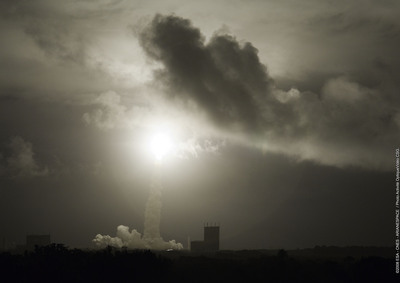
The European Space Agency (ESA) successfully launced its Jules Verne spacecraft from the Ariane Launch Complex in French Guiana, at 05:03 CET. On board is Jules Verne ATV, ESA's first Automated Transfer Vehicle.
After successfully achieving orbit, however, an on-board computer detected a problem with the mix of propellant in the spacecraft. ESA has suspended all burning of propellant until the issue can be fully investigated.
I'll update on this breaking news shortly.
SpaceHead
2008-03-07
Shuttle Launch on Tuesday!
Okay Spacers, here we go... it's time for a Shuttle launch!So, what's happening then?
On Tuesday March 11th at 06:28 GMT, Space Shuttle Endeavour launches to the International Space Station.
So, what are they doing this time?
 Space Shuttle mission STS-123 will deliver a habitable module and a robotic hand to the orbital outpost. Following hot on the heels of STS-122 in February, which delivered the European "Columbus" laboratory, the ISS is set to go from International to Global as Japan joins the fold with the first of three components. Canada continues to add its robotic expertise with a dextrous extension to the station's primary robot arm. The mission will close out with continued repair work on a failed joint that rotates the massive solar arrays to track the sun. The SARJ (Solar Array Rotary Joint) on the port side of the station has been only partially functional since NASA detected unusual vibrations and shut it down last year.
 The Japanese laboratory, named Kibo (Hope), consists of three parts. Two pressurised, or habitable modules, and one external facility. This mission delivers the smaller of two pressurized modules of Kibo, which will be attached temporarily to a docking port on the space-facing side of the station's Harmony node. It will remain there until May, when the next Shuttle mission, STS-124, delivers the second module. The final component, an external facility for performing experiments exposed to space, will be delivered next year.
 The Canadian robotic arm extension, known as Dextre, is effectively a robot "hand" that can manipulate objects with the same dexterity as a spacewalking astronaut. Dextre is an incredible feat of engineering which will allow astronauts inside the station to "plug in" to it through a virtual reality interface. They can use its cameras to see in 3D, and feedback from tactile fingers allow them to "grab" objects with finger sensitive touch. As much as the astronauts love to spacewalk, it is a time consuming and potentially dangerous undertaking. Dextre will perform many of the same tasks, ironically without the need to expose an astronaut to incredible views of his home planet!
Here's a cool animation showing Dextre in action.
STS-123 will be the longest mission to the ISS, with 13 full days docked to the station.
So, where can I watch all the fun?
The best online feed for NASA TV is at Yahoo. Click the Watch NASA TV link on this page.
So, TV is great and all, but can I see them in the sky?
Of course you can! Heavens-Above is a great resource for viewing. I have created a Spacers logon with several locations of known Spacers ready to go. Click the link, Login with the username: Spacers and password: spacehead and in the Configuration section click Switch Observing sites. If your location isn't there, please add it from the database. Then you can click the ISS link to see viewing opportunities at your location.
Look out also for the European Jules Verne spacecraft that is being launched on Saturday at 10:03 CT. It is the test flight of the European cargo delivery system that will resupply the ISS twice a year. The cool thing is that JulesV will wait in a parking orbit behind the ISS for a while so they can check it out, then after the Shuttle undocks it will move in for close maneuvers and docking. During this time the ISS, Shuttle, and Jules Verne will all be visible together in the sky. Look out for viewing opportunities on Heavens-Above.
I'll update the blog as the mission progresses, so happy spacing, spacers!
SpaceHead
2008-03-06
Spacers Is Alive!
Welcome Spacers, finally it has a home in the great wide Blogisphere!I'm just getting started on Blogger.com, so there might be some dust while I move stuff in. I'll kick things off in style... check out this cool picture of an actual avalanche on Mars, courtesy of HiRISE.

This is one of those images that even non-spacers can go ooooh at, because unlike boring pictures of dunes and craters this is an actual movey thing on another planet!
Go ahead and click it to view the entire JPL image, it's incredible. There are several avalanches in the same frame. We're looking down from orbit about 318km above an area very close to the martian North pole. The boffins are just starting to paw over the data but expect some more interesting stuff on this in the near future. I predict it won't be long before we get a stereo image and a before and after.
Stay spaced to this tune...
I'll be making an announcement soon, so for now, keep the space!
SpaceHead
Subscribe to:
Posts (Atom)

 Posts
Posts

